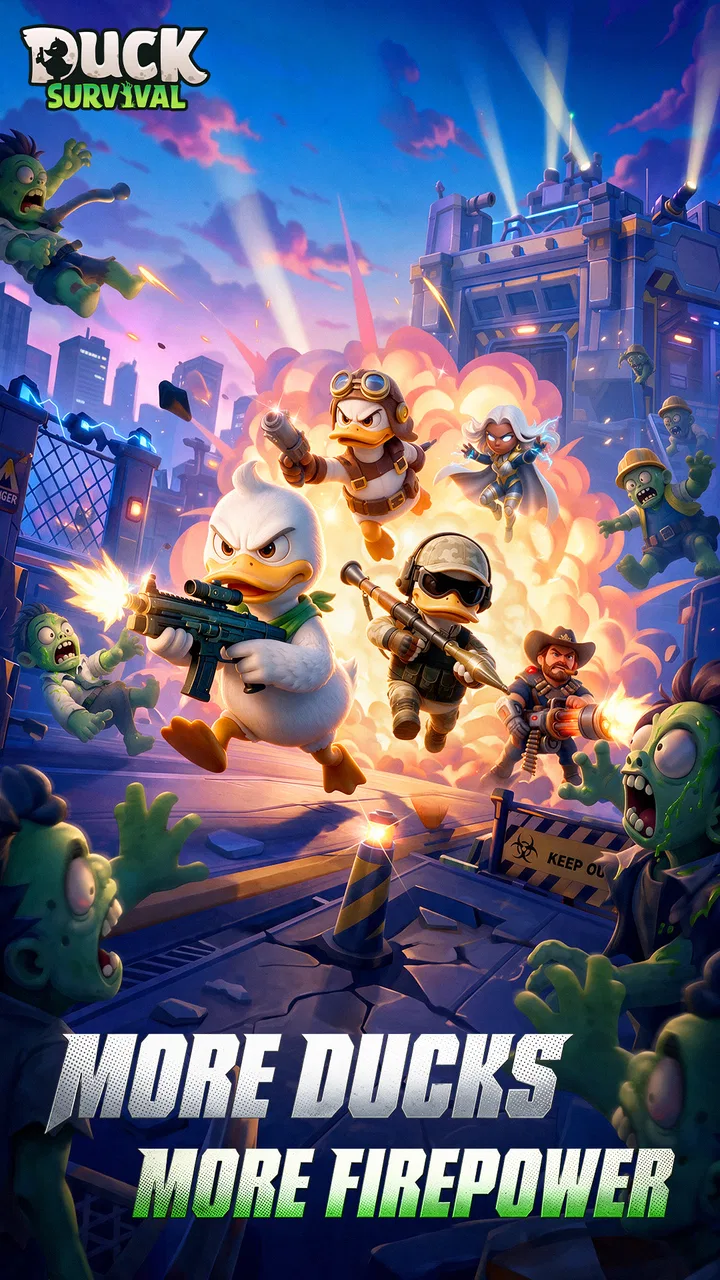
Duck Survival
- 4.7
- Rating
- 1.00M
- Installs
- Free
- Price

 Analysis by App-foxy
Duck Survival is the kind of strategy game that looks playful at first, then quickly asks you to make serious decisions. I spent time with this free game from Rhinos and found its central rhythm easy to understand: use daylight to prepare, then deal with danger after dark. That simple split gives each short session a clear purpose without burying the player under complicated menus or a long tutorial.
The appeal is not just the duck theme. What kept me interested was the tension between preparation and reaction. A careless daytime choice can make the night much harder, while a cautious approach may keep me safe but slow down my progress. It is a compact survival experience rather than a large, sprawling strategy simulator, and that distinction matters when deciding whether it belongs on your phone.
How the day-and-night structure shapes every decision
The game’s main idea is immediately readable. During the day, I focus on building and arranging what I need. When night arrives, the emphasis shifts toward shooting and surviving. This creates a natural two-part loop: planning first, pressure second. I never felt lost about what the game wanted me to do, even when the situation became hectic.
You May Also Like

 Blood Strike: 2.5 Anniversary
Blood Strike’s Loadouts Turn Every Drop Into a Tactical Gamble
A close look at Blood Strike’s custom loadouts: how fast access to signature weapons reshapes its battle royale rhythm, rewards preparation, and narrows the gap between fights.

 Pandora - Music & Podcasts
Pandora’s Music Is Easy to Start, but Harder to Recover
Pandora’s strength is its low-effort path from a seed to a station. Its weak spot is how much confidence it asks you to place in connection, setup, and quiet recovery.

 8 Ball Pool
 Is Built on Rivalries, Rematches, and Routine
A close look at the rivalries, rematches, shared routines, and unanswered safety questions that turn a quick pool match into a persistent mobile community.

 Samsung Music
’s Quiet Strength Is Playing What You Already Own
Its reach comes less from spectacle than from dependable access to a personal library. That simplicity is both the app’s strongest retention engine and its ceiling.

 AccuWeather: Weather Radar
AccuWeather Review: A Quick, Clear Forecast for Everyday Decisions
For everyday plans, the best forecast is the one you can understand quickly. AccuWeather makes rain timing, radar, and local conditions easy to act on, with a few trade-offs.

 Hill Climb Racing
Why Hill Climb Racing Still Turns Crashes Into One More Run
A tiny car, a bumpy hill and one more upgrade: Hill Climb Racing keeps resurfacing because its simple chaos makes every near-miss feel personal.
More From Our News Desk



That clarity makes the early goals satisfying. Instead of opening with a huge technology tree or a map full of unexplained icons, Duck Survival gives me a practical reason to act: prepare before the next threat arrives. The best early decisions are not necessarily the most ambitious ones. I found myself weighing whether to improve my immediate defenses or spend time making the next cycle more comfortable.
This is where the strategy category fits. The game is not simply an action shooter with a duck placed on top. Shooting matters, but the result depends heavily on what I did beforehand. Building during a safe period gives the later fight structure, and the night phase exposes weak planning very quickly. That relationship between the two phases is the game’s strongest design idea.
For a realistic everyday session, imagine playing during a short break. I can complete a preparation phase, enter the dangerous portion, and stop after reaching a natural pause rather than committing to a long campaign. If I have more time, I can continue experimenting with better ways to use the day. This makes the game more approachable than strategy titles that demand a large uninterrupted block of attention.
Early goals are clear, but the player must create priorities
The opening hours work best when I treat each cycle as a small lesson. I watch what causes trouble at night, then adjust my daytime setup instead of repeating the same plan. That feedback is more useful than blindly trying to build everything. The game encourages me to identify the immediate weakness in my defense and spend my limited attention there.
A useful habit is to avoid treating every daytime action as equally important. I first think about survival, then about efficiency. If I spend too much time chasing an attractive improvement while neglecting basic preparation, the night phase becomes a punishment for poor priorities. On the other hand, overbuilding can make the process feel slower than necessary. The most effective approach is to make enough progress to survive, then refine the setup after I understand the threat.
This creates one of the game’s less obvious strengths: the early objective is not merely “build more.” It is “build with the next night in mind.” That small change in mindset makes the loop more strategic. I am not collecting improvements for their own sake; I am trying to convert daytime choices into a safer and more manageable fight.
Players who enjoy visible, short-term objectives will probably settle into this quickly. Someone expecting a deep empire-building game may find the scope modest. Duck Survival gives me a focused survival problem rather than a broad world to govern, and its charm depends on whether that focused problem sounds enjoyable.
Progress feels strongest when I compare decisions, not just results
The clearest progress signal is learning how to prepare better. A failed or uncomfortable night tells me something about the setup that came before it. When I return to the next cycle with a different plan and handle the pressure more smoothly, the improvement feels earned. That kind of progress is personal and practical rather than purely numerical.
I also like that the day phase gives me a moment to think before the action begins. In many mobile strategy games, progression can feel like tapping through upgrades until the next reward appears. Here, the pause between building and shooting gives each improvement a reason. I can ask whether a change actually solves a problem or merely looks useful.
That said, players who need a constant stream of unlock notifications may find the progression less exciting. The satisfaction often comes from understanding the loop and making fewer mistakes, not from a dramatic story beat or a huge collection screen. The game’s retention depends on whether that kind of self-correction is rewarding to you.
My advice is to judge progress over several cycles rather than after one difficult night. A single rough attempt can make the game seem unfair, especially if I have not yet recognized which preparation choice caused the problem. Repeating the loop with one deliberate adjustment at a time makes the learning curve easier to read.
The challenge rises through pressure rather than needless complexity
Duck Survival’s challenge works because the two phases pull in opposite directions. Daytime feels like an opportunity, but it is also a deadline. Nighttime feels like a test, but it is also feedback. As the pressure grows, I have less room for inefficient preparation, and small mistakes become more noticeable.
I appreciate that the game does not need a complicated rulebook to create tension. The basic loop already supplies a meaningful trade-off: spend time preparing now, or accept a risk later. This makes the challenge accessible to people who are new to strategy games while still giving experienced players room to optimize their routine.
The trade-off is that the difficulty can feel demanding if I approach it like a casual shooter. Moving and firing are only part of the answer. If I ignore the building side, the action phase becomes harder than it needs to be. Players looking for instant, low-pressure entertainment should know that the game expects some thought between fights.
At the same time, it is not the best choice for someone seeking the layered complexity of a traditional strategy game. There is a difference between making tactical survival decisions and managing diplomacy, economies, research paths, or large armies. Duck Survival stays concentrated on its central loop, which helps it remain readable but limits its strategic breadth.
What keeps the loop going, and where retention can feel forced
The strongest reason to continue is the desire to improve the next attempt. I often wanted to see whether a more disciplined daytime plan would make the following night calmer. That is a healthy kind of retention because it comes from curiosity and mastery rather than from simply waiting for a timer.
The game also benefits from its unusual tone. A duck surviving a hostile night has a lighter personality than the usual grim survival setting, and that makes the pressure easier to approach. The presentation can attract players who would normally avoid darker survival games while still offering enough urgency to keep the action meaningful.
However, the compact loop can become repetitive if I am not interested in refining small decisions. There is no point pretending otherwise: the game’s replay value depends heavily on enjoying the build-then-shoot cycle itself. If I want constant new environments, a large narrative, or a broad collection of radically different play styles, another strategy game may offer more variety.
There are also optional purchases, ranging from small amounts to much larger per-item prices. I would approach those carefully and first decide whether the free loop already provides enough enjoyment. The game is free to start, but that does not mean every player will have the same tolerance for spending pressure. For me, the sensible approach is to play normally before considering any purchase and to avoid treating payment as a substitute for learning the preparation cycle.
That point is especially important for younger players. The content rating is Teen, so families should consider whether the shooting and survival pressure suit the intended player. The presence of in-app purchases is another reason to use the device’s purchase controls when children share the phone or tablet.
Who should play it and who should choose another strategy game
I would recommend Duck Survival to someone who likes short strategy sessions with a clear rhythm. It suits players who enjoy preparing a position, watching that plan face pressure, and making a better adjustment afterward. It is also a good fit for people who prefer a playful theme over the military or fantasy settings common in the genre.
I would be more cautious recommending it to players who dislike repetition. The game asks me to revisit the same broad structure, and the enjoyment comes from improving how I handle it. If repeating a familiar loop feels like work rather than experimentation, the duck theme alone may not carry the experience for long.
It may also disappoint fans of large-scale strategy alternatives. A base-building game with a persistent world, a tactics game with many units, or a resource-management title with several interconnected systems will likely provide more variety. Duck Survival is better understood as a focused survival challenge that can fit into ordinary mobile play, not as a replacement for a full desktop-style strategy experience.
For new players, I suggest resisting the urge to rush through the daytime portion. Use it to identify the most immediate problem, make one meaningful improvement, and then observe the result at night. That workflow gives clearer feedback than changing everything at once. It also helps answer the practical question many players have: whether a difficult night was caused by weak preparation, poor timing, or simply an unfamiliar threat.
Technical entry point and current value
The game is available at no upfront cost, which makes trying its central loop straightforward. It supports Android devices running at least version 5.1, so its compatibility reaches older phones as well as newer models. That is useful for anyone looking for a lightweight strategy game on a device that is not current.
Rhinos released it on April 8, 2025, and the current version is 1.3.9. Those details matter mainly because they show that the game is a relatively recent mobile release with an identifiable version to check when troubleshooting or deciding whether an update is available. I would still keep normal expectations for a mobile title: device performance and comfort can vary, especially during busy shooting sections.
The audience response is encouraging. It holds a 4.6 average from around 2.6 thousand ratings, while its review count is around 228. More than 100 thousand people have installed it, so the experience is not an obscure experiment with no visible player interest. Those figures do not guarantee that its particular loop will suit everyone, but they make it reasonable to give the free version a fair trial.
The Teen rating is worth taking seriously rather than treating the cartoon presentation as a complete explanation of the tone. The game combines survival pressure with shooting, so it is not simply a harmless building toy. I found the style approachable, but parents and younger players should still make the decision based on the actual content and the player’s comfort level.
My verdict on goals, pacing, and long-term appeal
After playing it, I see Duck Survival as a focused strategy game with a strong central hook. Its goals are understandable from the beginning, its progress is easiest to feel through improved decisions, and its challenge comes from making daytime preparation count when night arrives. The pacing is at its best when I play in short, deliberate sessions and treat each cycle as an experiment.
The game does not try to be everything. It does not offer the broad management depth of a major strategy alternative, and its repeated structure may lose players who need constant novelty. Those are real limitations, not minor details. The free entry point makes them easy to evaluate without committing money first, although the available in-app purchases mean I would keep spending controls in mind.
My overall recommendation is to try it if you enjoy learning through repeated survival decisions. The most satisfying moments come from recognizing a weakness, changing the daytime plan, and seeing the night become more manageable. If that kind of gradual mastery sounds better than a long campaign or a huge upgrade tree, this duck-themed strategy game has a clear reason to stay installed.
For me, the progression verdict is positive but specific: the loop sustains play because preparation has visible consequences, not because the game overwhelms me with content. I would recommend Duck Survival to casual strategy players, mobile users who value compact sessions, and anyone curious about a lighter survival setting. I would skip it in favor of a larger strategy alternative if my priority were extensive systems, constant discovery, or a deep long-term campaign.
FAQs for Duck Survival
01What is Duck Survival and how do I play it?
Duck Survival is an action-packed adventure game available on both Android and iOS. In this game, you control a duck navigating through various challenges and obstacles. To play, you must tap and swipe to move the duck, collect coins, and avoid hazards. The goal is to survive as long as possible while achieving high scores.
02Are there in-app purchases in Duck Survival?
Yes, Duck Survival offers in-app purchases. Players can buy coins and special items to enhance their gameplay experience. While the game is free to download, these purchases can help you progress faster or customize your duck with unique skins and abilities. Always check the app store for detailed pricing information.
03Is Duck Survival suitable for children?
Duck Survival is designed to be family-friendly, with colorful graphics and simple controls suitable for all ages. However, parents should note the presence of in-app purchases and ensure that parental controls are set up if needed. The game is rated for everyone, but it's always a good idea to supervise younger players.
04What are the system requirements for Duck Survival?
To run Duck Survival smoothly, Android users need a device with at least Android 5.0, while iOS users require iOS 11.0 or later. The game is optimized for most smartphones and tablets, but having a device with good processing power and adequate storage space will enhance your gaming experience.
05How often are new updates released for Duck Survival?
The developers of Duck Survival actively release updates to introduce new levels, features, and bug fixes. Updates are typically rolled out every few months, ensuring the game stays fresh and exciting. It's recommended to enable automatic updates on your device to enjoy the latest content and improvements.
Pros
- Engaging survival mechanics.
- Smooth and intuitive controls.
- Vibrant and unique graphics.
- Frequent updates with new content.
- Offline play available.
Cons
- Ads can be intrusive.
- In-app purchases are pricey.
- Limited character customization.
- Occasional performance lags.
- Requires significant storage space.

Duck Survival
Gallery